Turkey Breast Roast Temp & Time with Leave-In Thermometer
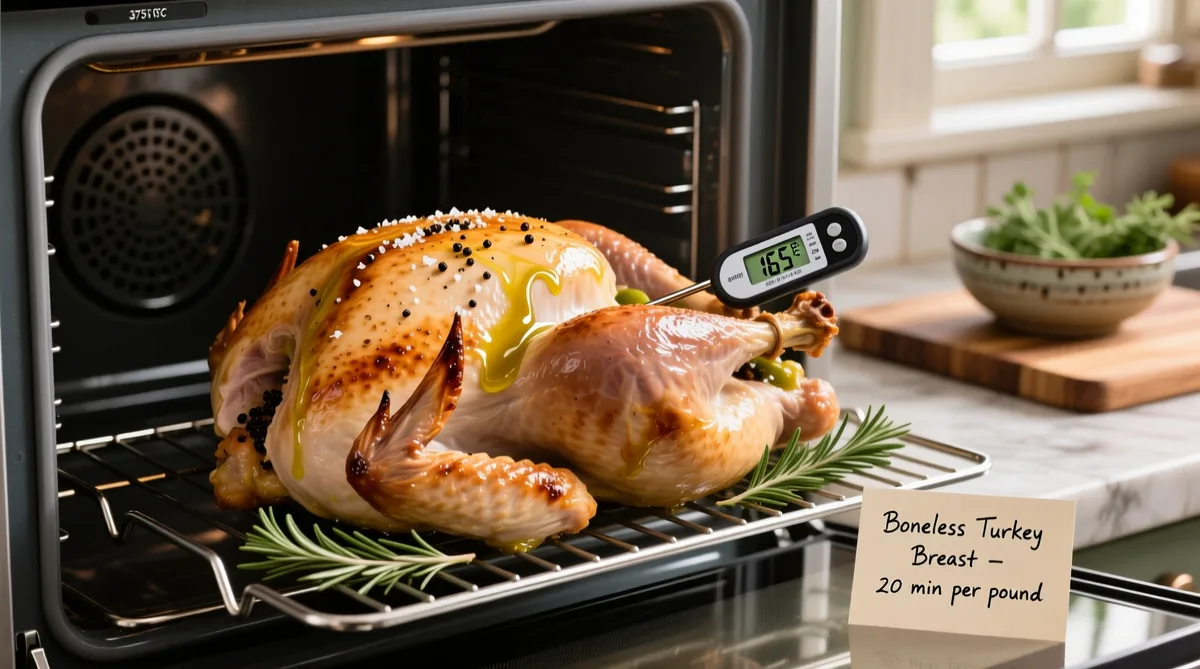
The countdown is on. It's 6 AM on Thanksgiving morning, and you've got a turkey breast to roast. You've read five different recipes with three different cooking times, and everyone online is arguing about whether it's 20 minutes per pound or 15.
You might be wondering what temperature and cooking time for roasted thanksgiving turkey breast in leave in oven safe meat thermometer will actually work without drying out the meat.
The answer, as you're about to find out, isn't a simple formula. The USDA sets the safe minimum internal temperature for turkey at 165°F, but how you get there matters more than the time on the clock. Here's what the research and real kitchen experience say about nailing it this holiday.
Image source: Bing (Web (fair-use with source credit))
Why Getting Turkey Breast Temp Right Matters More Than Cook Time
Every Thanksgiving, thousands of turkey breasts end up as dry, rubbery disappointments. Not because the cook was careless, but because they trusted the timer instead of the thermometer. The moment you rely solely on minutes per pound, you're gambling with the most important meal of the year.
Here's the reality: cook time is a suggestion, internal temperature is a fact. Your oven might run hot or cold. Your turkey breast might be thicker on one end.
The shape, bone structure, and starting temperature of the meat all change how long roasting actually takes. Two identical-looking turkey breasts can finish at completely different times.
That's why a leave-in oven-safe meat thermometer earns its spot in the drawer every November. It lets you track the temperature rise without opening the oven door and losing heat. And because you're not constantly yanking the pan out to poke at the meat, your turkey cooks more evenly from start to finish.
A recent aggregate review of cooking thermometers confirms that digital leave-in probes eliminate most of the guesswork and produce significantly more consistent results than pop-up timers. Pop-up timers, which come pre-inserted in many store-bought turkeys, trigger at around 165°F. That sounds perfect, but the problem is they activate from heat penetration alone, not necessarily from the coldest part of the breast being fully cooked.
The Quick Answer: Target Internal Temp, Roasting Times, and Why You Pull Early
Roast your turkey breast at 325°F to 350°F. Set your leave-in thermometer alarm to 162°F (the USDA safe minimum internal temperature for poultry is 165°F). Pull it out, rest it for 15 minutes, and the carryover rise will take it to 165°F safely.
| Oven Temp | Bone-In Breast (minutes/lb) | Boneless Breast (minutes/lb) | Pull-Out Temp |
|---|---|---|---|
| 325°F | 20-25 | 18-22 | 158-162°F |
| 350°F | 15-20 | 15-18 | 158-162°F |
| 375°F (convection) | 12-15 | 10-12 | 158-162°F |
Cooking time per pound is a starting estimate, not a guarantee. Always defer to the thermometer reading. The shape of the breast and whether the bird was brined will shift these times by several minutes per pound.
Most importantly, pull the turkey when the probe reads 158°F to 162°F. The internal temperature will climb another 5°F to 10°F during the rest. If you wait until the probe shows 165°F while it's still in the oven, you're overcooking it.
By the time you carve, the breast will be well past 170°F or even 175°F. That's the difference between juicy and sawdust.
Carryover cooking works because heat continues to move from the hotter outer layers into the center. The larger the cut, the more carryover you'll see. A boneless turkey breast gains roughly 7°F during a 15 minute rest, while a bone-in breast typically climbs by around 5°F.
How a Leave-In Oven-Safe Thermometer Works (and What to Look For Before You Trust It)
A leave-in thermometer has two main parts: the probe (the metal spike) and the display (the base). You insert the probe into the meat, run the heatproof cable out of the oven, and connect it to the display on your countertop. The probe continuously measures the internal temperature and sends the reading to the display so you know exactly how your turkey is doing at any given second.
The key difference from an instant-read thermometer is the cable. It's designed to withstand oven temperatures, typically up to 600°F to 700°F, without melting or fraying. Not all cables are created equal, so checking the max temperature rating on the manufacturer spec sheet matters.
If your thermometer came with basic instructions, follow the calibration guidelines. Most digital probes stay accurate out of the box, but it's worth doing a quick ice water test before Thanksgiving. Fill a glass with ice, add cold water, stir, and insert the probe.
It should read 32°F. If it's off by more than 2°F, either calibrate it per the manual or plan to use a backup probe.
What about the probe itself?
Look for a thin probe tip (around 1/8 inch) and a fast response time. Thicker probes create larger puncture wounds in the meat, letting more juice escape. Speed matters too, though with a leave-in thermometer you're not waiting for a reading, you're monitoring a continuous trend.
The display should show three things clearly: target temperature, current temperature, and an alarm or countdown. Models with preset poultry settings are nice, but manual target setting is just as good. Wireless models with Bluetooth and phone apps add convenience, especially if you're running around hosting, but they're not essential for a properly handled bird.
Probe Placement: The #1 Mistake and How to Insert It Correctly
The perfect thermometer is useless if you put the probe in the wrong spot. Incorrect probe placement is the most common reason a turkey breast comes out either dangerously undercooked or parched. Here's where the tip needs to be: the thickest part of the breast meat, completely away from bone.
Insert the probe horizontally from the side of the breast, not from the top. This gives you a reading from the coldest, slowest-cooking area. The probe tip should sit dead center in the thickest part of the muscle, about 1.5 to 2 inches deep.
Make sure it's not touching the breastbone, any pocket of stuffing, or a large deposit of fat.
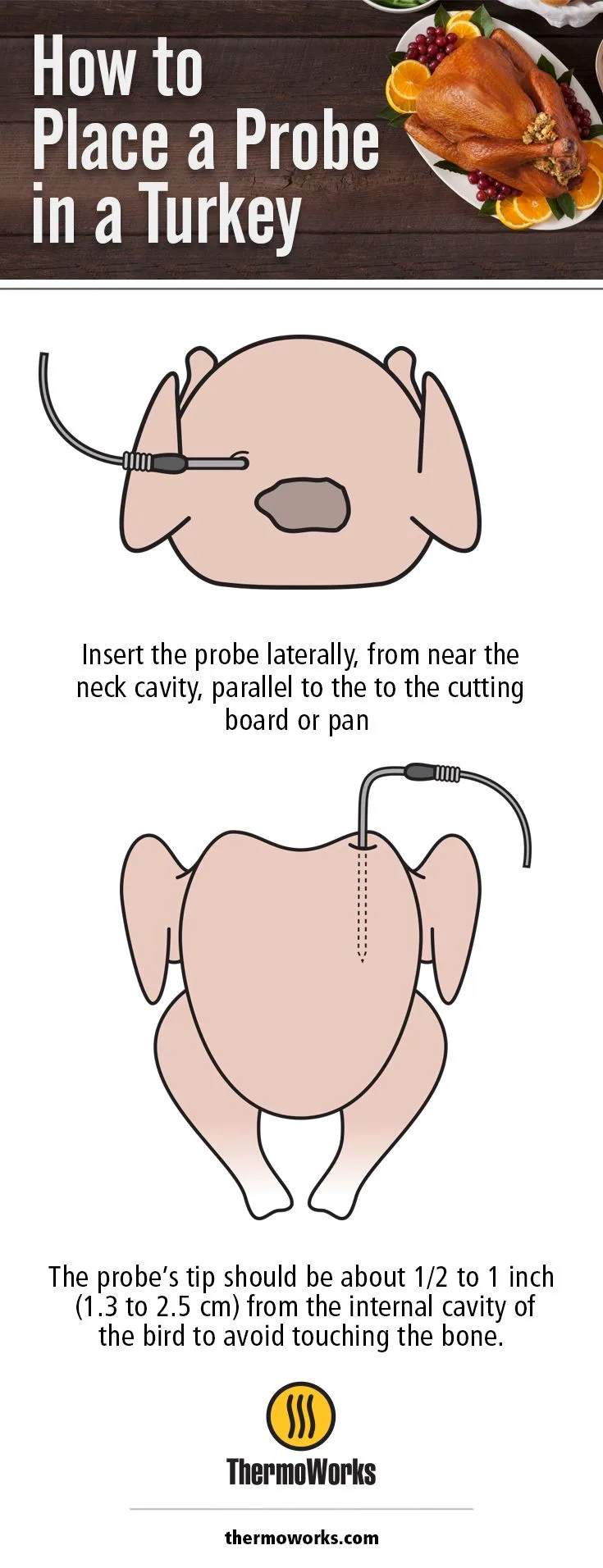
Image source: Web (Bing) / pinterest.com (Web image (fair-use with source credit))
Here's a few placement rules that make a real difference:
- Stay clear of bone. Bone conducts heat faster than meat. If the probe tip touches the bone, you'll get a false high reading and pull the bird early, while the meat around it is still raw.
- Avoid fat pockets. Fat heats faster than muscle. A probe in fat tells you the fat is done, not the meat.
- Don't go too shallow. If only the tip of the probe is in the meat, you're measuring the surface temperature, which is up to 15°F hotter than the center.
- Use the side, not the top. Side insertion helps the probe stay seated and keeps the tip in the thickest area.
If you're roasting a split breast with the bone in, feel for the keel bone (the breastbone running down the center) and aim just to the side and slightly above the point where it meets the neck cavity. For a boneless breast, insert at the plumpest point, angling slightly downward toward the center.
How to route the cable so the oven door seals properly
Run the cable out of the oven at the top corner, where the door meets the frame. This area has a small gap, and the heat-resistant cable handles contact with the metal just fine. Just don't shut the cable directly in the latch mechanism, and don't let it touch the heating elements.
325°F vs 350°F: The Real Numbers for Bone-In and Boneless Turkey Breast
The temperature you choose affects the texture of the finished meat. Both temperatures produce excellent turkey when you pull at the right internal reading, but they behave differently in practice.
Roasting at 325°F is gentler. It gives the heat more time to penetrate the thickest part of the breast muscles, which means the outer layers don't overcook before the center catches up. This is the classic, reliable route.
Aggregate cooking guides and food safety sources consistently cite 325°F as the sweet spot for poultry because it reduces the temperature differential between the outside and the inside. The downside? It takes longer.
A 4 pound bone-in breast at 325°F might need around 1 hour and 20 minutes, while the same piece at 350°F is often done in roughly 1 hour.
Roasting at 350°F shaves 10 to 15 minutes off the overall cook time, which helps when your side dishes are stacking up and the oven is only so big. The tradeoff is less margin for error. If your oven runs hot, or your probe is placed slightly off, the breast can cross into dry territory faster.
The center still reaches the right temperature, but the outer slices will be noticeably more done than the middle.
Here's a good rule of thumb: if you're using a convection oven, drop the temperature by 25°F. Convection moves hot air around the cavity, which speeds up cooking and promotes that crisp, golden skin. A convection oven at 325°F cooks more like a conventional oven at 350°F.
Which one should you pick?
Use this simple breakdown:
- 325°F if you're roasting a bigger, bone-in breast (5+ pounds), want more even cooking, or are using a basic thermometer without an alarm.
- 350°F if you're short on time, roasting a smaller boneless breast, or need your oven free sooner.
- Convection at 325°F if your oven has it and you like crispy skin with a fast cook.
Remember that the oven temperature might not match the set dial. Even good ovens cycle. The actual air temperature can swing 15°F to 25°F above and below the set point during cycling.
This natural variation is exactly why the probe reading on the meat, not the oven's thermostat, should be your source of truth. A second probe that monitors ambient oven temperature is a nice luxury, but it's not required.
Common Mistakes That Dry Out or Under-Cook Turkey Breast (Even With a Thermometer)
Even with a perfect leave-in thermometer, things can still go sideways. These are the mistakes that show up again and again in verified buyer feedback and cooking forums.
Trusting the pop-up timer. That little plastic button that came with your turkey is notoriously unreliable. It triggers only after the surrounding meat reaches roughly 165°F, which usually means the breast has already blown past 180°F. By then, the meat is dry and stringy.
Toss it and rely on your probe.
Opening the oven door to "check." Every time you crack that door, the oven temperature drops dramatically. A modern oven might recover quickly, but old models can lose 50°F and take minutes to climb back. Worse, you're interrupting the carryover process and slowing the overall cook.
Trust the probe and keep the door shut.
Roasting at too high a temperature. 400°F and up will crisp the skin fast, sure, but it also creates a huge temperature difference between the outer meat and the center. You end up with a golden, crunchy exterior and a center that's still 145°F. When you finally hit a safe reading, the outside is overcooked leather.
Misjudging a boneless breast. Boneless turkey breasts cook faster, but they also dry out faster. The lack of bone means less insulation and a thinner muscle. Dive in with a boneless breast and you're committed to checking that probe reading at least every 10 minutes after the hour mark.
Skipping the rest. It's the oldest rule in the book. You pull the turkey at 160°F, it rests, and the temperature climbs the rest of the way. Skip that rest period and the juices run out all over the cutting board.
Even a five minute rest makes a real difference. A full 15 minutes transforms the texture.
What about brining?
Brined turkey holds moisture better and tolerates a little more heat. A dry-brined breast can often be pulled at 160°F and still hit 170°F during the rest without tasting dry. An unbrined breast doesn't have that buffer.
Pull that one closer to 158°F.
If you see pink meat near the bone around the thigh, that's normal. And if the probe reading looks frozen for five minutes, that's fine. The internal temperature can stall as the meat's juices heat up and the collagen breaks down.
Step-by-Step: Roasting a Turkey Breast With a Leave-In Probe, From Prep to Rest
Now here's the full sequence, from the moment the turkey hits the counter to the moment it rests on the cutting board. This process works for bone-in and boneless breasts alike.
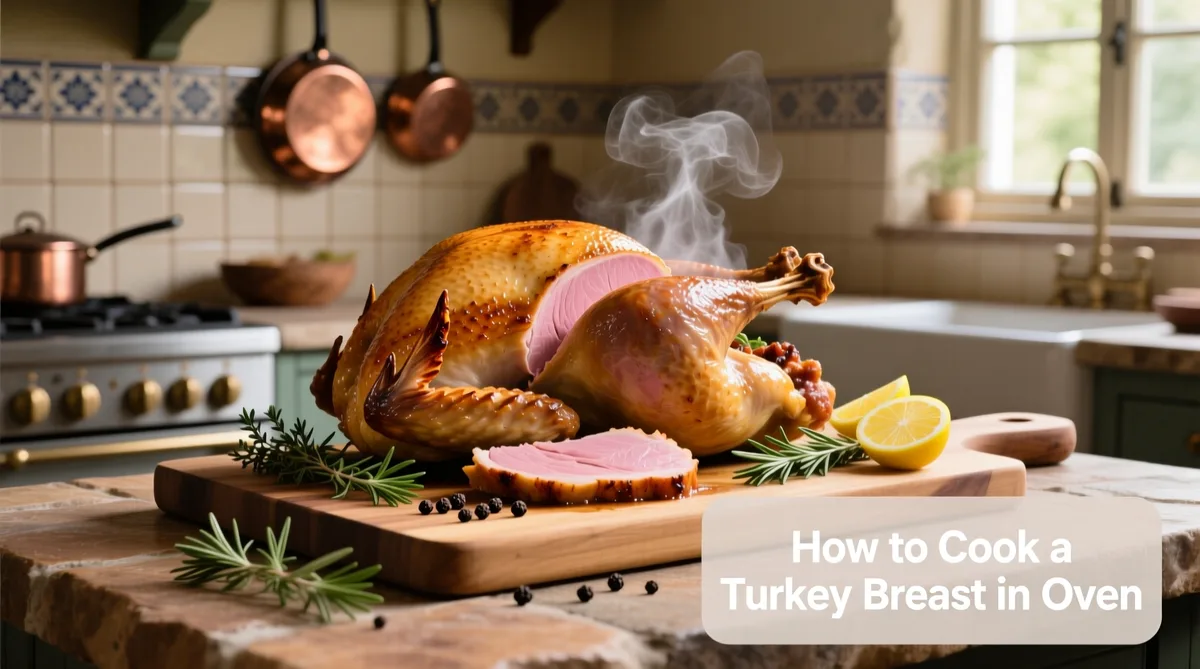
Image source: Web (Bing) / spice.alibaba.com (Web image (fair-use with source credit))
Step 1: Bring it to room temperature. Pull the turkey breast out of the fridge 30 to 40 minutes before roasting. This isn't about safety, it's about even cooking. A cold center takes longer to heat, so the outside absorbs more heat while the inside plays catch-up.
The USDA recommends keeping raw poultry refrigerated below 40°F until you're ready to cook, so don't leave it out longer than an hour.
Step 2: Preheat and prep the pan. Set your oven to 325°F or 350°F. Use a shallow roasting pan (about 2 inches deep). For faster cleanup, line it with foil.
Add a rack if you have one, it keeps the breast out of the drippings and helps the heat circulate underneath. You don't need a trivet of carrots and celery. That's for flavoring the pan drippings.
Step 3: Season and insert the probe. Pat the skin dry with paper towels. Rub with oil, salt, pepper, and any herbs you like. Insert the probe horizontally into the thickest part of the breast, at least 1.5 inches deep, away from the bone.
Route the cable out the top corner of the oven door and close it gently.
Step 4: Roast until the probe hits your pull temperature. Place the breast in the oven and set the probe alarm to 158°F (boneless) or 160°F (bone-in, because carryover is slightly lower). For a 4 pound bone-in breast at 325°F, that's roughly 1 hour and 15 minutes. For a 3 pound boneless breast at 350°F, plan on around 45 to 55 minutes.
Step 5: Tent and rest. When the alarm sounds, pull the pan out. Transfer the breast to a cutting board and loosely tent it with foil. Let it rest for 15 minutes.
The internal temperature will climb to a safe 165°F during this time. Don't poke it, don't slice it, don't peek. Let the juices redistribute.
Step 6: Carve and serve. Slice against the grain, starting from the thickest part of the breast. Save the pan juices for gravy or spoon them over the slices at the table.
Troubleshooting Your Leave-In Thermometer: Calibration, Malfunctions, and Backup Plans
Leave-in thermometers are reliable, but they're not invincible. When a reading looks wrong, here's how to figure out what your probe is actually telling you.
The reading is climbing too fast. That's usually a placement issue. Pull the probe out, wipe it clean, and reinsert it deeper into the meat. If it's in the thinner end of the breast, the reading will be quicker than the center.
Move it toward the thickest part.
The temperature hasn't moved in 15 minutes. This can be a stall, but it's more often a probe that's slipped out of position. If the meat has rested and you can't confirm the probe is seated properly, check that the cable hasn't been pulled by the weight of the turkey. You might need to reinsert the probe.
The reading is 165°F but the meat looks raw. Don't trust a single source. Pull the breast out and double-check with an instant-read thermometer in the thickest part, away from the bone. If it still reads above 165°F, it's safe.
If it doesn't, your leave-in probe is either faulty or placed wrong. Calibrate it and try again.
Calibration in 30 seconds
Fill a glass with ice and water. Wait two minutes. Insert the probe into the slurry, making sure it doesn't touch the glass bottom.
It should read 32°F. If it's off by more than 2°F, consult the manual. Some thermometers allow field calibration; others need a factory reset.
As a final check, boil water and test the probe at 212°F.
| Problem | Likely Cause | Fix |
|---|---|---|
| Temp climbing fast | Probe too shallow | Reinsert deeper |
| Stuck reading | Probe out of meat | Reseat probe |
| Reading off by 3°F+ | Needs calibration | Ice water test |
| Alarm ringing early | Fat or bone contact | Reposition probe |
| Display reads "Err" | Cable damaged | Use backup probe |
The cable is damaged. If the display shows an error code, blinking, or nothing at all, inspect the full length of the cable for cuts or melted spots. Oven-safe cables resist heat, but they don't resist a sharp pan edge. A backup instant-read thermometer is your safety net for the holiday.
You lost the alarm signal. With wireless models, the base can be too far from the oven or the app crashes. Keep the base near the kitchen and double-check the connection before you start roasting. If it drops out mid-cook, rely on the display on the base unit itself.
USDA Food Safety Rules: Handling, Resting, Leftovers, and When to Trust the Reading
The USDA Food Safety and Inspection Service sets the gold standard for poultry safety. Their guidance is simple: cook turkey to a minimum internal temperature of 165°F, measured in the thickest part of the breast, the inner thigh, and the wing joint. This temperature is not arbitrary.
It kills pathogens like Salmonella and Campylobacter in seconds, making the meat safe to eat.
The 2026 food safety guidelines continue to emphasize that temperature, not time, is the definitive way to gauge doneness. Recipes and look-and-feel check are unreliable. But here's the nuance: you don't have to hit 165°F in the oven.
The USDA recognizes that pathogens are destroyed during the rest period, as long as the meat holds at or above 165°F momentarily. That's exactly why pulling at 158°F to 160°F and resting works, as long as the residual heat carries the temperature up.
Handling raw turkey safely
Remember the basics: wash hands and surfaces after contact with raw turkey. Use separate cutting boards for raw meat and vegetables. And never reuse marinade that touched the raw bird.
The USDA also recommends refrigerating turkey within two hours of cooking. If you're serving a buffet, keep it on a warming tray or chafing dish to hold at 140°F or above.
What about leftovers? Slice all leftover meat off the bone and refrigerate it within two hours. Stored in shallow containers, cooked turkey keeps in the fridge for three to four days. In the freezer, it stays good for four to six months.
Reheat leftovers to 165°F before eating. Gravy should be reheated to a rolling boil.
When to trust the reading completely. If your leave-in thermometer is calibrated, properly placed, and reads 165°F in the center of the breast, you're safe. The USDA says whole turkey is safe at that point, even if the meat near the bone still looks pink. That discoloration is a chemical reaction from gases in the bird's bone, not a sign of rawness.
Two more safety notes. First, don't stuff the turkey breast cavity. Stuffing takes longer to reach 165°F than the meat itself, and it's a common cause of undercooked stuffing.
Second, if you're roasting a whole turkey, check the temperature in three spots: the thickest part of the breast, the inner thigh, and the wing joint. All three must hit 165°F. With a breast only, that single probe reading does the job.
FAQs: Your Turkey Breast Temp and Leave-In Thermometer Questions, Answered
Can I cook a frozen turkey breast without thawing first?
Technically yes, the USDA allows it. Plan for roughly 50 percent longer cooking time. The probe must still read 165°F in the center.
But you'll sacrifice even cooking and texture. Thawing in the refrigerator for one to two days is the better route.
What temperature should the oven be for a turkey breast?
325°F to 350°F is the sweet spot. If you use a convection oven, set it to 325°F, since the moving air cooks faster. A 375°F oven works, but only for a small boneless breast, and you'll need to watch the probe closely to avoid drying it out.
Why does my turkey breast take longer than the recipe says?
Ovens run differently, and a breast that's thicker on one side takes longer. The shape of the cut matters more than the weight. Your probe reading is the only reliable measure.
If you're at 325°F and the cook is dragging, the oven thermostat might be running low.
Should I pull the turkey at 165°F if I'm using a leave-in thermometer?
Not if you want juicy meat. Pull it somewhere between 158°F and 162°F. The temperature will rise another 5°F to 10°F during the rest, landing right at 165°F or just above.
That's safe and tender.
Can I reuse my leave-in thermometer probe after Thanksgiving?
Absolutely. Wash the probe with hot, soapy water. Most probes are waterproof or dishwasher-safe, but check the manual.
Wipe the cable clean, coil it loosely, and store it away from sharp utensils. Calibrate it again before next use.
What's the best way to get crispy skin if I pull the turkey early?
Blast it with high heat for the last five minutes of roasting, or finish it under the broiler. Remove the probe first. Watch it closely.
A quick sear at 500°F or broil will crisp the skin without changing the internal temperature much.

Related posts
Can You Use High-Fat Meat in a Jerky Gun Safely
So you've got a pack of ground meat with more than 15% fat, a jerky gun kit, and…
How to Clean Herb Dust from Dehydrator’s Rear Fan Grille
If you've noticed your quiet digital food dehydrator taking longer to dry herbs, or a faint burning smell…
KitchenAid Pro 600 Review: Reddit Says Buy or Skip
If you are searching for "is kitchenaid pro 600 6qt bowl lift commercial stand mixer worth buying reddit…